
Tarrant City Directory Shelves
Tarrant County’s historical directory record is a set of overlapping shelves, not one uninterrupted annual run. The Texas State Library’s Fort Worth directory holdings begin with 1877 and extend through 1989 in selected editions. Its separate Fort Worth Suburban holdings begin in 1963 and continue in selected years through 1993. Those dates describe volumes held, not proof that every missing year was printed, preserved, or searchable. A search should start with the closest surviving year and make the gap part of the research note.
| Collection | Years | Where Held | Access |
|---|---|---|---|
| Fort Worth printed directories | 1877 through 1989, selected holdings | Texas State Library, Fort Worth History Center, Tarrant Archives | Shelves, microfilm, catalog, and selected scans |
| Fort Worth Suburban directories | 1963–79, 1981–82, 1985, 1987–88, 1990–91, 1993 | Texas State Library and Tarrant Archives | Repository request or reading-room use |
| Morrison & Fourmy Fort Worth directory | 1914 | UTA / Portal to Texas History | Free digitized item |
| Polk Fort Worth runs | Selected 1952–81; 1991 and 1995 holdings | Tarrant County Archives collections | Collection list and onsite access |
| Cole Fort Worth and Greater Fort Worth runs | 1975, 1978–87, 1989, 1991 | Tarrant County Archives collections | Collection list and onsite access |
| North Fort Worth and Wallace address volumes | 1904–05, 1905–06, 1907–08; street occupancy 1909–10; Wallace 1975 | Molenburg collection and Tarrant Archives | Finding aid and physical-volume request |
These Tarrant collection holdings are especially useful when a modern place name is too broad. Fort Worth, Arlington, Mid-Cities, North Fort Worth, and suburban coverage do not always line up. Record the volume’s title and geographic scope before deciding that a missing name means the person was absent.
1914 Tarrant City Directory Scan
The Portal to Texas History’s 1914 Directory of the City of Fort Worth identifies Morrison & Fourmy Directory Co. as compiler and publisher. The item is about 790 pages and includes individual and business address listings, advertisements, and government, postal, and court reference pages. It is a strong dated starting point for Tarrant research because the item can be read remotely rather than inferred from a catalog title.
The digitized 1914 Fort Worth directory item shows the collection’s title-page context before any name is transcribed.
Use the image as a check on the item’s date, publisher, and scope. A name or address should still be copied from the exact page image, because the text-only item record did not expose one selected resident line for a reliable sample transcription.
Tarrant City Directory Publisher Runs
Publisher names help place a Tarrant search in the right repository. The Tarrant Archives book container list identifies Polk’s Fort Worth holdings for selected years from 1952 through 1981, alongside later 1991 and 1995 holdings. It also identifies Cole volumes, including Greater Fort Worth and Vicinity in 1991. The District Attorney collection lists Cole’s Fort Worth for 1975, 1978–87, and 1989.
One publisher label cannot supply a continuous residence history. The archive list also records Polk Arlington editions, Fort Worth Suburban volumes, and the 1975 Wallace Street Guide. Check the actual edition’s city coverage and avoid treating a directory for one part of Tarrant County as a countywide roster. Identify each volume by its publisher, year, and geographic label before comparing its lines.
The Archives directory-holdings list is the right starting point for comparing Polk, Cole, suburban, and Wallace entries.
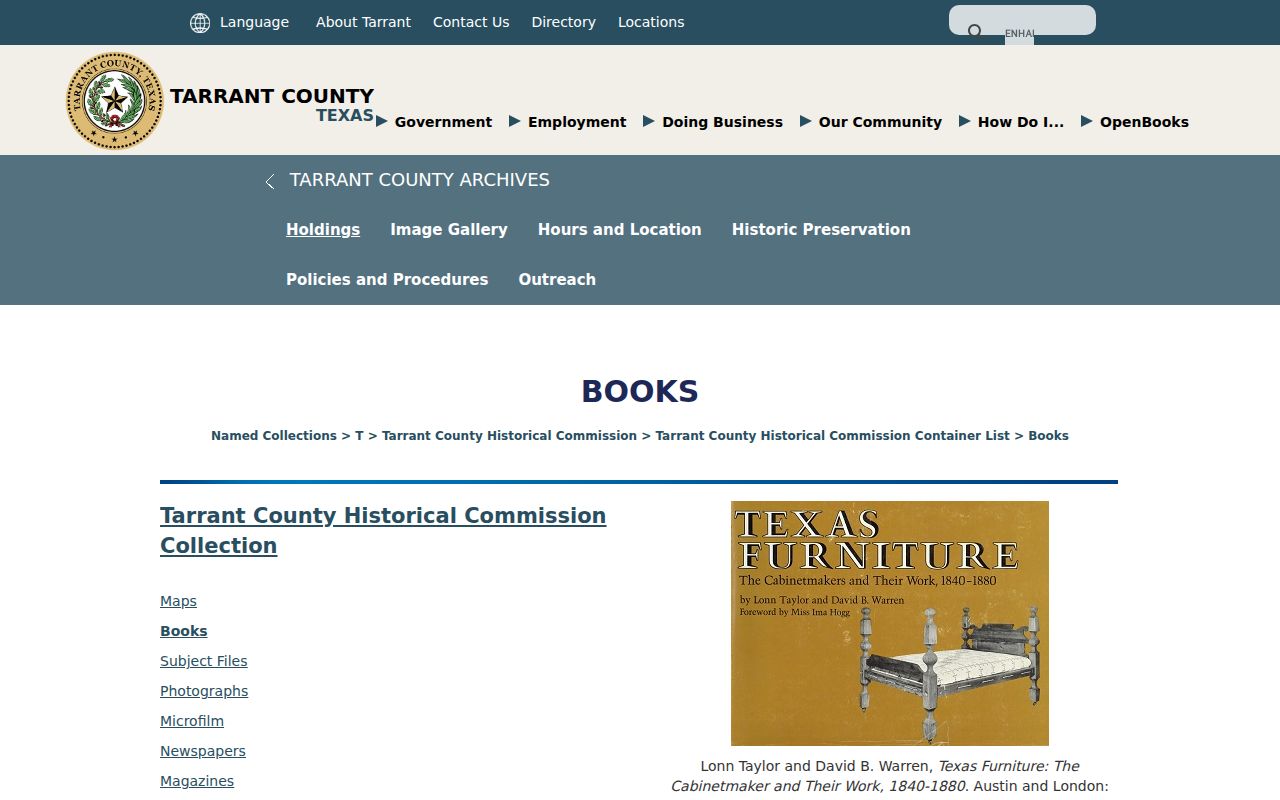
That holdings view documents the shelf trail, while the physical volume or scan supplies the line that supports a person, address, or business finding.
Tarrant City Directory Address Sections
The address-oriented clue in these collections is uneven but valuable. North Fort Worth city directories survive for 1904–05, 1905–06, and 1907–08, and the Judy R. Molenburg collection includes a North Fort Worth Street Occupancy volume for 1909–10. Tarrant Archives also holds the 34th-edition 1975 Wallace Street Guide, covering Fort Worth, Arlington, and Mid-Cities. These are the strongest located sources for working from an old address toward an occupant lead.
A reverse or criss-cross section, when an edition has one, is organized by street address rather than surname. It can identify a person to research in the alphabetical portion, but it does not prove that every person at an address appears. Apartments, businesses, abbreviations, city boundaries, and missing editions all change what a line can mean.
- Criss-cross directory
- An address-order section that can turn a street and number into an occupant lead when that section exists in the edition.
- Householder index
- A name-oriented arrangement that may point to the person listed for a household, rather than every person living there.
- Abbreviation key
- The edition-specific explanation for shorthand. Read and preserve it before expanding any mark in a transcription.
Reading a Tarrant City Directory Line
Start by copying what is printed, including punctuation, initials, street spelling, directional prefix, and city label. The 1914 item description confirms individual and business address listings. A typical line may also include an occupation or business affiliation, and some editions may use spouse, widow, or householder notation. Those extra details are edition-specific. Do not add an occupation, spouse relationship, owner status, telephone number, or meaning for an abbreviation unless the exact scanned page and its key show it.
| Printed name | Copy surname, given name, initials, and spelling exactly before trying variants. |
|---|---|
| Street address | Transcribe the number, street, direction, and city label as printed. |
| Individual or business line | The 1914 item includes both; identify which section supplied the entry. |
| Occupation or affiliation | Record only when it appears in the exact edition being read. |
| Spouse, householder, or widow notation | Use only if visibly stated and retain the edition’s own abbreviation. |
A historical name that needs a present-day check belongs in a separate record trail. The Tarrant resident lookup uses current public custodians rather than asking an old directory line to prove a current address.
Tarrant City Directory Sources Compared
The Fort Worth History Center at 501 E. Bolt Street is the local fallback when a catalog entry, digitized item, or archive list is not enough. It offers finding aids, an online catalog, Digital Archives, directories, yearbooks, newspapers, maps, and genealogy databases. Its archives are stored offsite, so staff request an appointment and at least three business days for retrieval. Material remains in the building, and copying can depend on condition and copyright.
Access differs by resource. The Center lists onsite Ancestry Library Edition, while HeritageQuest Online and Texas Reference Center are also named among its databases. Tarrant County Archives adds historic marriage licenses, probate abstracts, cemetery material, school-census records, directories, and the Fort Worth Genealogical Society’s Footprints. Footprints runs from 1957 to 1997, with digitized early years and later physical copies. Its transcriptions should be checked against originals because corrections continue.
Tracing Tarrant City Directory Households
Use the nearest surviving Tarrant editions as dated observations, not a claim of continuous occupancy. A household can move, be omitted, appear under initials, or be listed under a business address. Pairing the printed line with a census, tax-list, deed, map, or obituary source makes it easier to distinguish people with the same name and to report an uncertain interval honestly.
- Normalize the printed address, including its direction, city label, and spelling.
- Find the closest surviving alphabetical listing and transcribe the line exactly.
- Check an address-order section when that edition includes one, then compare the name section.
- Repeat with the nearest available directory years and label each result present, absent, moved, or ambiguous.
- Pair the result with the federal census through 1950, tax lists, deeds, newspapers, or probate material as the date requires.
The federal census is publicly available through 1950 under the 72-year release rule. Tarrant tax lists run from 1850 through 1981 but are arranged by surname initial, not as a modern address search. The three sources work best as separate dates: a directory line, a census household, and a tax-list appearance are not interchangeable proof.
Tarrant City Directory Time Breaks
Tarrant’s directory story begins with the Swasey and Melton 1877 Fort Worth volume, moves through Morrison & Fourmy’s 1914 directory, and continues in selected Polk, Cole, and suburban runs. The sequence matters because the absence of a year is often a holdings gap, not evidence that a person vanished. North Fort Worth and outer-city coverage also have their own runs.
- 1877: Swasey and Melton’s Fort Worth directory establishes the early printed run.
- 1904–10: North Fort Worth directories and the street-occupancy volume add a separate address layer.
- 1914: Morrison & Fourmy’s roughly 790-page Fort Worth item is digitally accessible.
- 1952–95: Selected Polk and Cole holdings document later Fort Worth and metro-area runs.
The March 29, 1876 courthouse fire destroyed most early county deed and district-court material. That loss does not erase the directory trail, but it explains why a pre-fire research chain may rely on surviving probate, abstracts, transcriptions, maps, and later records instead of a complete courthouse file.
Tarrant City Directory Map Context
Historic maps keep a printed address in its period. The 1893 Fort Worth Sanborn item and the 1910 Fort Worth Sanborn volume show buildings, streets, uses, and surrounding landmarks, not resident names. The 1910 volume has 88 sheets. Tarrant Archives also lists a 1912 Fort Worth street-layout map and a 1919 North Fort Worth map in its maps and plans database.
No official countywide street-renumbering year was located. When an old number conflicts with a current street line, compare the relevant map, directory, legal description, and city context address by address. Newspapers, funeral programs, yearbooks, the Digital Archives, and Footprints can add a dated community record, but they should never be turned into a claim that a person lived at an address without the original context.