
Tarrant Previous Residents Source Years
Past-resident research works best as an era map. The current tax parcel supplies the modern anchor, the deed index carries the legal-description trail, and historic materials add the people and building layers. The online Tarrant County Official Records system does not state its earliest searchable year. A web result that stops is therefore a limit of the portal, not proof that an earlier transfer or household never existed.
| Source | Years It Covers | Where Held | What It Shows |
|---|---|---|---|
| County Clerk historical record base | 1876 forward in surviving county records | County Clerk, Official Records Search, and office terminals | Deeds, plats, and instruments; most earlier deed and district-court material was lost |
| Tarrant Official Records Search | Current portal; earliest online year not stated | County Clerk online search | Grantor, grantee, subdivision, document type or number, recorded date, index and OCR modes |
| Fort Worth city directories | 1877 and selected years through 1989 | History Center, Tarrant Archives, Texas State Library | Name, address, and business lines, with gaps between editions |
| North Fort Worth street occupancy | 1909–10 | Tarrant Archives, Molenburg collection | Address-oriented occupancy clues |
| Sanborn Fort Worth maps | 1893 item; 1910 volume | Portal to Texas History and Library of Congress | Buildings, streets, uses, and landmarks, not a resident roster |
| Federal census and Tarrant tax lists | Census through 1950; tax lists 1850–1981 | Library and genealogy resources | Household and surname-initial context, not a continuous address file |
For recent previous residents, start at the parcel and official deed image. For older questions, work outward to maps, directories, tax lists, census schedules, newspapers, and archival abstracts. The result should be a dated chain with visible gaps, not a guessed list of everyone who may have lived there.
Tarrant Previous Residents Begin at TAD
The Tarrant Appraisal District Property Search supplies the present-day anchor for a previous-residents trail. Its parcel card can show the account number, georeference, situs address, primary owner, primary owner address, legal description, subdivision, site number, and instrument reference. Save the date of the card in a research note because tax values and owner fields can change.
Four fields need separate treatment. The situs address identifies the land. The primary owner is the current taxable owner shown on the card. The primary owner address is a tax-notice destination, which may be the same site, a post-office box, a business office, or another city. The legal description identifies the parcel in recorded instruments. Keeping those fields apart prevents a mailing destination from being presented as a place where a person lived.
The current parcel only begins the backward trail. Carry its instrument reference and legal description to the Clerk rather than assuming a tax-card reference itself proves the type or contents of a deed.
Tarrant Previous Residents: Index or OCR
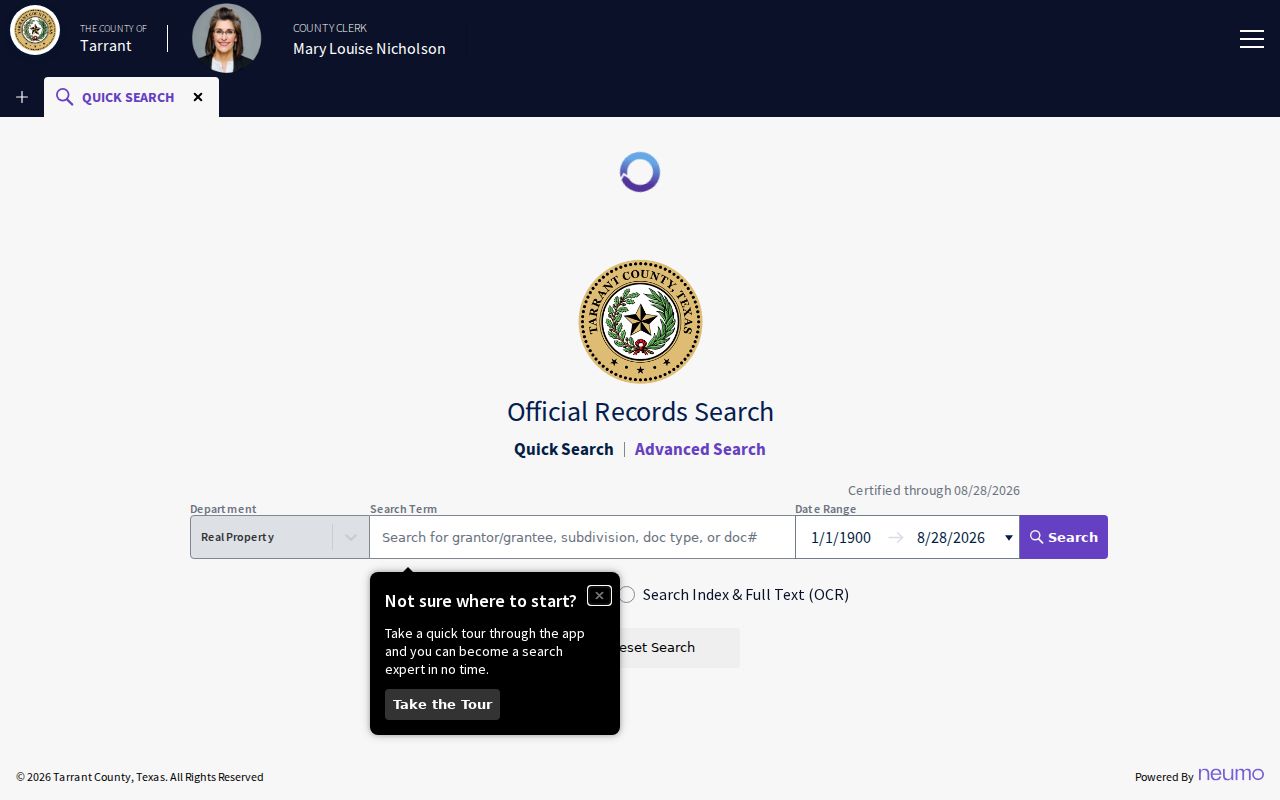
The Tarrant County Official Records Search can search a grantor or grantee, subdivision, document type, document number, and recorded-date range. Start with Index Only for named indexed parties. Use Search Index & Full Text when a subdivision phrase, legal description, or document wording is the better lead. The two modes answer different questions: Index Only searches indexed fields individually when multiple words are entered, while OCR treats multiple words as a phrase and can misread names.
The County Clerk’s Official Records Search shows the term and date controls used to begin an address-to-deed search.
An index result is a lead, not the full record. Open the deed image and record its grantor, grantee, recording date, document number, instrument type, and complete legal description. Correction deeds, survivorship language, trustee instruments, and plats can change the chain, so one matching index line should never end the review.
Tarrant Previous Residents and 1876
The sharpest break in Tarrant County’s address history is the courthouse fire of March 29, 1876. County historical material corrects older references that call it a 1875 fire. Most early commissioners-court loose papers, district-court records, and deed records were destroyed. Some surveyor, sheriff, and chief-justice records survived, and probate material survived in part. A blank pre-fire deed search is therefore a records-history gap, not a negative finding about a person or parcel.
The District Clerk reports that historical files spanning 1876–1950 are being imaged, while Tarrant Archives offers separate historical ledger scans and finding aids. For an older address, shift the question to what survived: probate abstracts, marriage ledgers, later re-recording, abstracts, tax lists, maps, newspapers, and directory lines. Label the source type because an abstract, scanned ledger, and original deed do not carry the same weight.
Tracing Tarrant Previous Residents by Deed
Follow recorded transfers backward from the present parcel, not from an untested old surname. A legal description is often the bridge when an address has changed or never appears in the instrument. A subdivision, block, and lot can be searched in the index; a metes-and-bounds parcel may need its survey or abstract description. The County Clerk does not conduct title, lien, or restriction searches, so unresolved priority or missing-instrument questions require a title professional or attorney.
- Open the current TAD parcel and record the instrument reference and complete legal description.
- Search the instrument number, legal description, or named party in Official Records, with a recorded-date range.
- From the deed image, capture the buyer, seller, date, document number, instrument type, and legal description.
- Search the seller as a prior buyer, then repeat around the earlier transfer date.
- When the address disappears, search the subdivision, block, lot, survey, abstract, or metes-and-bounds language instead.
- Stop and document any break that the index, image, or parcel description cannot reconcile.
- Grantor
- The party transferring an interest in the recorded instrument, commonly the seller in a deed.
- Grantee
- The party receiving that interest, commonly the buyer in a deed.
- Chain of title
- The dated sequence of recorded transfers for a parcel. It is not complete until the relevant instruments are examined.
- Legal description
- The parcel description used in recorded land records, such as a lot and block or survey language. It can bridge a changed street number.
Tarrant Previous Residents Access Paths
When the online search stops, the County Clerk offers more than one route. Unofficial real-property images are available online after account registration. Copies are also available through public terminals in the basement records area, Room B20 and B30 counters, and a mail request. The County Clerk’s real-property copy instructions list $1 per page and an additional $5 for certification. The mail route requires payment and a self-addressed stamped envelope. These options expand access, but they do not establish that every historic book has been scanned.
The Fort Worth History Center at 501 E. Bolt Street is the local fallback for directories, maps, newspapers, yearbooks, finding aids, and genealogy databases. Its archives are stored offsite, so researchers need an appointment and at least three business days for retrieval. Supply the exact address, suspected former names, legal description, and date range with a request. No official countywide packaged house-history service was located in the inspected materials.
For map context, compare the 1893 Fort Worth Sanborn item, the 1910 Fort Worth Sanborn volume with 88 sheets, and the Tarrant Archives 1912 Fort Worth and 1919 North Fort Worth maps. They can date the built setting and street layout, but they do not name each resident.
Tarrant Previous Residents Through Old Addresses
Historic address work has a local mismatch worth keeping visible. The 1912 Fort Worth map and the 1919 North Fort Worth map preserve city-limit and street context, while a current parcel may use a later city boundary or a different street line. No authoritative countywide street-renumbering year was located. Do not assign one. Compare the older directory spelling and number to the map, legal description, and adjacent landmarks one address at a time.
Sanborn sheets date structures, outbuildings, uses, and neighboring parcels rather than persons. Fort Worth permits and certificate-of-occupancy data can date work at a site, but an applicant, contractor, or code contact is not automatically a resident or owner. A permit is supporting physical evidence, not a substitute for a deed or household source.
Tarrant Past Residents in Context
Ownership is only part of the past-residents question. Fort Worth directory holdings begin in 1877, and the Molenburg collection’s 1909–10 North Fort Worth street-occupancy material can add an address-oriented clue. The historical shelves themselves are cataloged in the Tarrant city directory collections. Use an address line to guide a name search, then pair it with census, tax, map, or newspaper evidence rather than treating it as a continuous occupancy claim.
The federal census is available through 1950 under the 72-year release rule. Tarrant tax lists run from 1850 through 1981 and are arranged by surname initial. When a household disappears, search the History Center’s Early Fort Worth News from 1873–1882, the Star-Telegram holdings identified from 1897 forward, and other local publications. Tarrant Archives adds probate abstracts for 1866–1959, immigrant declarations from 1878–1895, school-census records for 1919–1970, and cemetery material. An obituary or probate abstract can supply an endpoint, but neither is a current-address record.
The people-layer sequence is: directory line → census household → tax-list or deed context → map or permit date → obituary, cemetery, or probate endpoint. Each item needs its own date and repository note.
Tarrant Previous Residents Boundaries
Past-resident research is best suited to family history, estate and heir questions, house history, or checking an old address in its historical context. The records distinguish ownership, a tax mailing address, a directory listing, and a household clue. They do not create a complete roll of everyone connected to an address, and protected information or records not released by a custodian remain outside the trail.