
Tarrant Resident Lookup Records
A Tarrant resident lookup is a cross-check, not a single master list. The Tarrant Appraisal District can tie an owner or entity to a taxable parcel, while the voter tool can confirm a registration match and districts. The County Clerk's records link named parties to deeds, plats, liens, and other filed instruments. Courts, probate files, and state vital indexes answer still different questions. Each source has a distinct time range and privacy rule, so its result should be described only for what it actually establishes.
| Record | What It Can Confirm | Custodian | Access Path |
|---|---|---|---|
| Taxable parcel | Owner, tax-notice address, situs, and legal description | Tarrant Appraisal District | Public search, not proof of occupancy |
| Voter registration | Registration match, status, address, and districts | Tarrant County Elections | Name, date of birth, and State Voter ID; protected records may be suppressed |
| Recorded instrument | Grantor, grantee, document type, and filing date | Tarrant County Clerk | Index online; image and certified-copy channels differ |
| Court or probate file | Party role, case number, dates, and case events | Applicable court clerk | Portal search plus clerk copy or counter route |
| Vital index | Event-year clues and marriage or divorce verification | Texas DSHS | Historical access rules apply; recent copies are restricted |
| State filing | Entity, agent, member, officer, or license detail | Texas SOS or licensing board | Board-specific public search or paid state search |
Choose the record from the question in hand. An address question begins with TAD Property Search. A transfer question belongs in the County Clerk Official Records Search. A registration question belongs with Elections. None of those records proves that every person in a household currently lives at the parcel.
Tarrant Resident Name Variants
Write down the name before searching. Include middle initials, maiden names, hyphenated forms, suffixes, common misspellings, and the order in which a compound surname may appear. That short preparation matters in Tarrant County, where a name-only result can point to several properties, voter entries, or dockets. Search the cleanest version first, then compare the alternatives rather than merging them into one assumed identity.
Use an address, an age or date, a spouse or relative, an entity connection, a legal description, or a case number as the second detail. TAD separates the property's situs from the primary owner mailing address. A situs is the parcel's physical location, while a mailing address is where tax notices go. They can match, but they can also be a post-office box, office, or another city. That distinction is central when a resident lookup begins with an owner name.
Note: A same-name result without a second independent detail is a lead, not an identification.
Tarrant Court Records Crosscheck
For a named court record, narrow by court, county, date, and case number. re:SearchTX requires an account and offers search cards for Cases, Filings, Text in Documents, and Hearings. It can expose parties, attorneys, events, register-of-actions information, and available documents, but coverage varies by court and electronic filing date. The cited statewide report describes cases from 2016 and excludes criminal records, so a local clerk remains the authoritative route for a missing or criminal case.
The official re:SearchTX court search surface is shown here. It is a useful way to turn a party name into a case number before asking the proper clerk for the record.
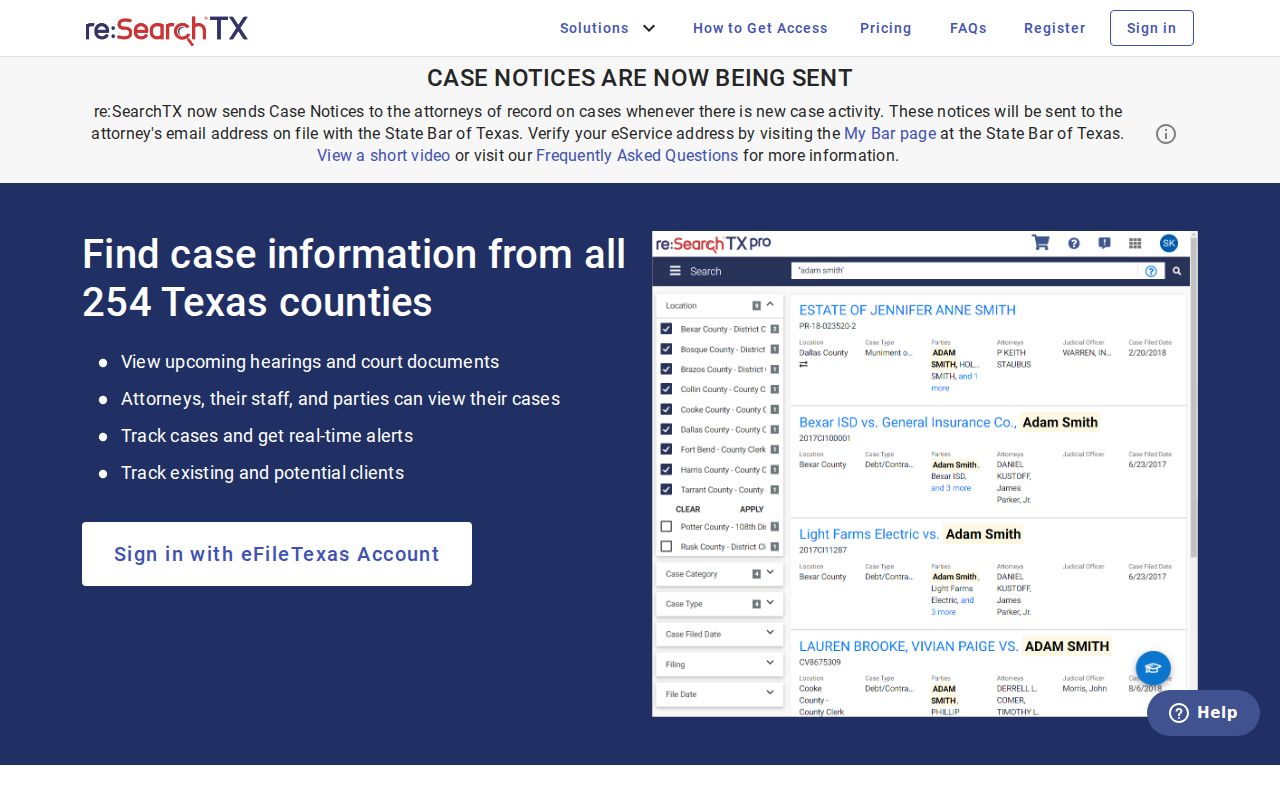
Once a case number is known, save the court name and filing date with it. That record trail is much safer than relying on a bare name match.
| Search Result Detail | What It Means |
|---|---|
| Case number and style | Identifies the proceeding and named parties for a clerk request |
| Attorney or party role | Helps distinguish similar names, but does not show current residence |
| Event, hearing, or disposition | Places the record in time and shows procedural status |
| Linked filing | May be available through the portal or only from the custodian |
Fort Worth Municipal Court is narrower. Its current docket searches defendant name, courtroom, time, or case number and returns Name, Court Room, Time, and Case Number. It is not a historical countywide index. Hearing records and related copies follow the Municipal Court clerk's inspection and request path.
Tarrant Voter Lookup Boundaries
The Tarrant County Voter Lookup asks for last name, first name, date of birth, and State Voter ID. A matching result can show the state and county voter IDs, name, address, voter status, precinct, districts, and an election-history link. It does not produce a household list. The address can be suppressed, and a protected voter or Address Confidentiality Program participant may not appear through the ordinary display.
This Tarrant resident lookup source should be used to confirm a registration match, not to infer who else resides at an address. Elections voted in may be public in the applicable record context, while ballot choices are not. When a privacy setting blocks the web result, the documented route is to contact Tarrant Elections rather than trying to reconstruct a protected address.
The voter lookup form displays the name, date-of-birth, and State Voter ID search fields. The screen helps document the limited purpose of a registration check.
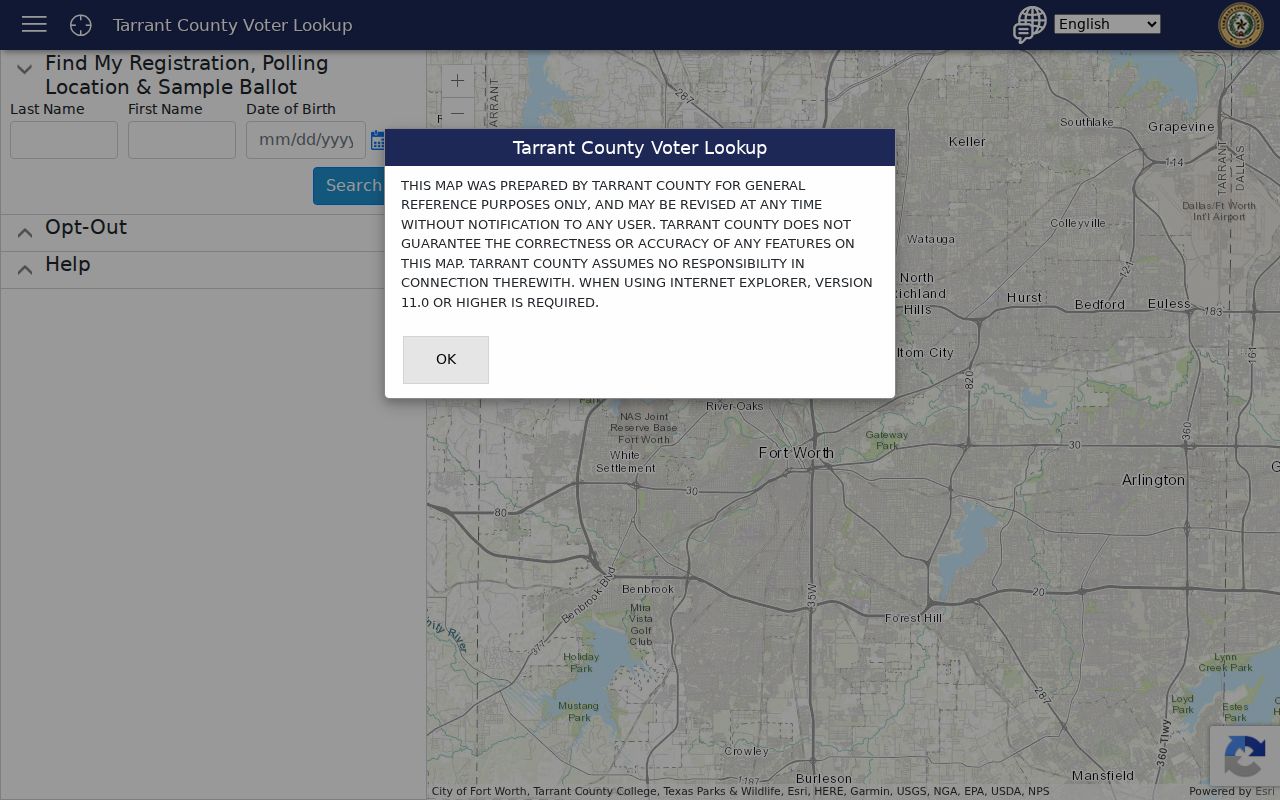
A voter result adds one independently dated public record. It does not replace a deed image, a certified record, or an address confirmation from the right custodian.
Tarrant Vital Record Paths
Birth, death, marriage, and divorce records do not come from one office. Tarrant County Clerk is the local registrar for births and deaths in its covered areas and keeps county marriage licenses. The District Clerk holds local divorce case files. Texas DSHS maintains statewide birth and death access plus marriage and divorce verifications. A verification letter is not the certified marriage license or divorce decree held by the county custodian.
Texas makes birth records public after 75 years and death records public after 25 years, with a separate rule for unidentified decedents. DSHS has digital birth indexes from 1925 and death indexes from 1965, at $10 per event year, and earlier microfiche begins in 1903. Recent certified records have eligibility rules. Marriage verification begins in 1966 and divorce verification in 1968, while certified local documents come from the clerk where the event was recorded.
The DSHS vital applications page lists the state forms used for certificate, verification, adoption, paternity, and correction routes.
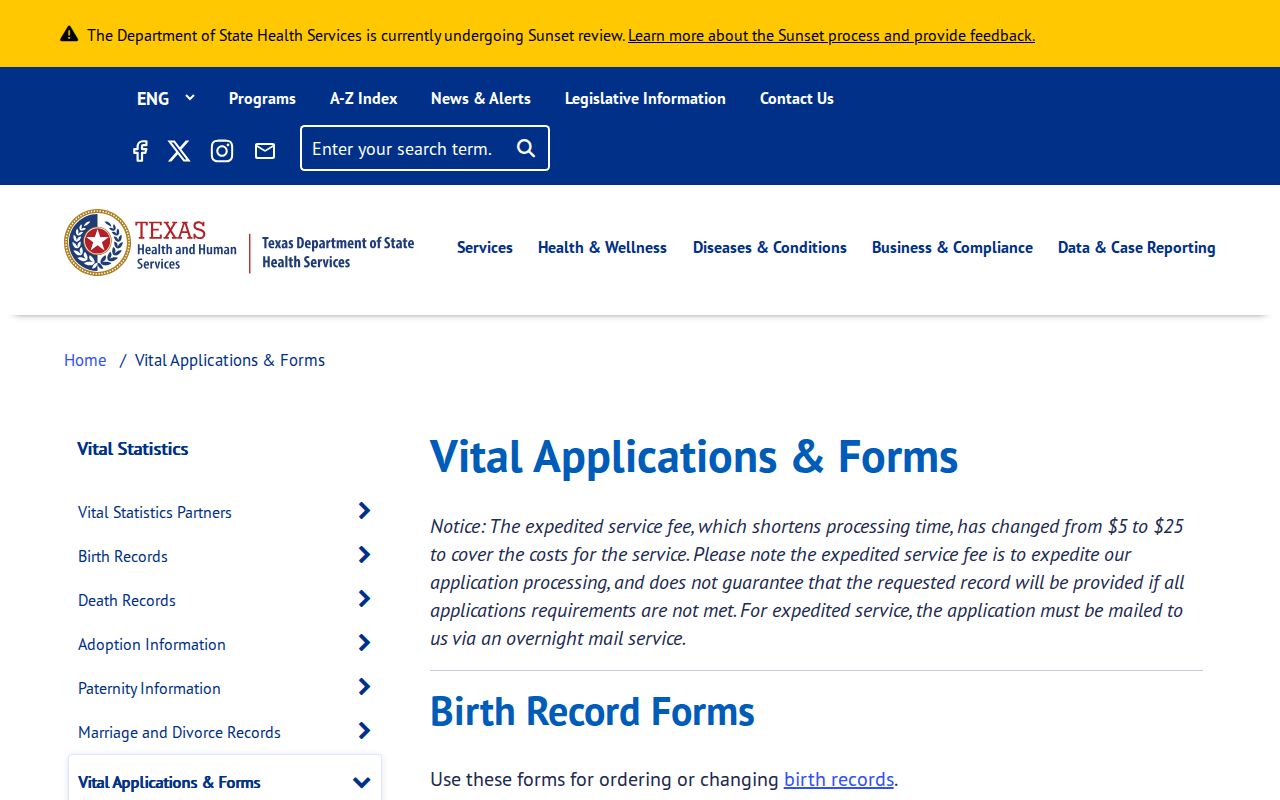
Use an index entry as an event clue, then request the correct document only through the office and eligibility path that applies to it.
Tarrant Resident Match Checks
A careful resident lookup moves from a name to a record that has a second anchor. The sequence below keeps the owner roll, registration record, court index, and vital path in their proper roles. It also prevents a current tax-mailing address or a court appearance from being reported as proof of where someone lives.
- Search the name variants in TAD by owner name or property address and record the situs, primary owner address, legal description, and instrument reference separately.
- Use the instrument reference or legal description in the Clerk index. Compare the named grantor or grantee and recorded date with the parcel result.
- Check voter registration only with the required name, date-of-birth, or State Voter ID fields, then compare the displayed status and districts without treating it as a household roster.
- Search the appropriate court by party name and narrow the result by court and date. Request the underlying record by case number when the file is needed.
- Confirm the identity with two independent details, such as an address and legal description, age and date, relative, entity connection, or court number.
- Docket
- A court's running list of cases, hearings, and events. It can identify a proceeding but may not establish an address.
- Index and image
- An index is a searchable record summary. An image is the filed document itself and may have a separate account, copy, or certification path.
- Certified copy
- A copy authenticated by the custodian for an official purpose. It is different from a free or view-only image.
Historic family research can add a dated address from a directory or yearbook, but it should remain dated. The Tarrant city directories offer the historical collections route when a modern name search has reached its limit.
Tarrant Probate and Filing Clues
Probate can be the better route when the question concerns an estate or heir. Tarrant Probate Courts and the County Clerk hold estate, guardianship, will, and related records, and the Archives offers early probate abstracts for 1866 through 1959. A filed executor or heir address is a dated lead, not a current-address conclusion. Sealed portions remain outside a public resident lookup.
For a person connected to a business, SOSDirect can search entity, registered-agent, officer, member, manager, and filing history for a $1 statutory search fee. County assumed-name records and relevant licensing-board profiles can help distinguish similar names. An agent or office address may belong to a service provider, so it should not be recast as a home address.
Texas ClaimIt can also connect a name or business to a property ID, holder, and claim route. Proof is still required to make a claim. It is a name lead, not identity proof.
Tarrant Record Correction Paths
When a record is wrong, start with its own custodian. Preserve the page address, access date, screenshot, and record or case number. Send a parcel-card correction to TAD, a filed-index issue to the County Clerk, a registration issue to Tarrant Elections, and a license issue to the board that published it. These offices do not correct each other's data. The Clerk has a local redaction path for sensitive identifiers appearing in real-property documents.
The Texas Public Information Act, Government Code chapter 552, supplies the fallback for identifiable government records not available online. A written request may go by mail, email, in person, fax where available, or an online portal. Governmental bodies generally respond promptly. When an exception is claimed, an Attorney General ruling request is generally due within 10 business days. A request should describe the records sought, not ask an office to investigate a person.
Note: Keep the custodian's response with the original record so a later correction can be traced.
Tarrant Lookup Privacy Limits
A Tarrant resident lookup has deliberate gaps. Recent vital records, adoption material, juvenile and sealed cases, protected voter records, Address Confidentiality Program information, ordinary utility customer data, and motor-vehicle personal data are not general public resident sources. The Texas Address Confidentiality Program uses a substitute post-office box and mail forwarding for qualifying participants. Online suppression and other voter confidentiality rules also apply.
Lawful use. Use Tarrant records for personal, family-history, civic, or other lawful research. Texas harassment and stalking laws still apply when a public record is used to threaten, monitor, contact, or intimidate someone.
Public information needs context. A parcel card is an ownership and tax record, a voter result is a registration record, and a docket places a person in a proceeding. Confirm important information with the custodian and respect every protected-record boundary.